First stab at an article summarising this research.
This is work in progress. Please consult this page for
updates in the future.
Abstract
Introduction
Across the globe states have implemented Green Deal policies and priorities. Air transportation accounts for about 2-3% of annual CO2 emissions, however, the total amount of CO2 emissions constantly increased pre-COVID.
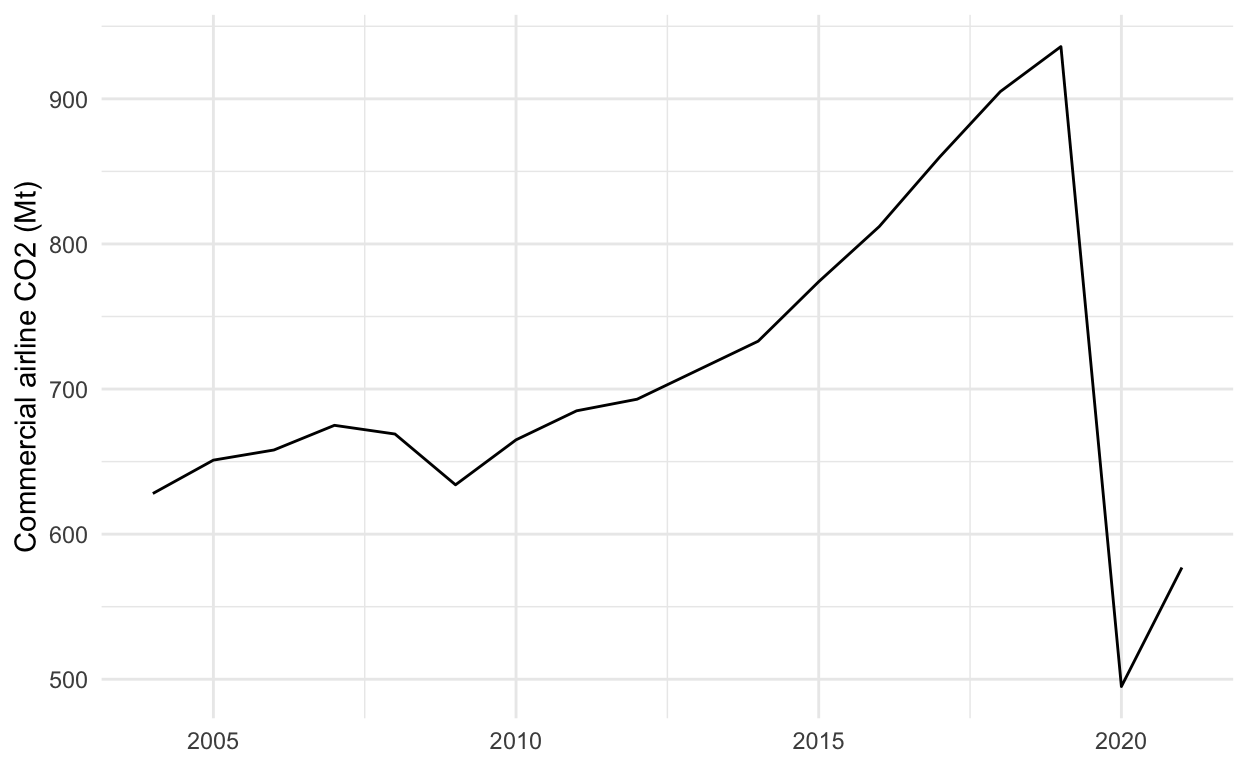
Figure 1: Annual emissions by commercial aircraft 2004-2021
Fig 1 shows the total emissions of commercial flights as reported by IATA (IATA 2019).
Levers for fuel reduction:
- operational efficiency
- market-based measures
- sustainable aviation fuel
- new aircraft propulsion and airframes
A wider use and pick-up of sustainable aviation fuel, and new aircraft propulsion technologies or aircraft design requires further research. Despite the introduction of an initial market-based mechanism, immediate action to curb fuel burn and CO2 emissions rests with improvements of operational efficiency.
ICAO promotes a performance-based approach. The Global Air Navigation Plan (GANP) proposes indicators for regional benchmarking (ICAO 2019). However, there is no detailed guidance on how to measure additional fuel burn.
Fuel burn per se is known to the aircraft operator. While the actual fuel burn and fuel flow during the flight is recorded (e.g. flight data recorder), these data are not commonly shared. Acoordingly, a wide variety of models have been developed to estimate fuel burn (and associated emissions) for different applications. Applications range from global emission inventories to low-level analytics. The work within these application fields is regularly challenged by the fact that aircraft emission calculations require proprietary engine data which usually is difficult to obtain.
This work builds on openly available engine emission data. The goal is to build simple estimation model applicable for performance benchmarking to keep calculation complexity reasonably low. The overall aim it to develop an approach suitable for regional operational performance comparisons. This apporach trades off complexity versus accuracy. Total emission estimates shall therefore be considered as rough point estimates.
The contribution of this paper are as follows:
- development of supporting material to estimate fuel burn / CO2 emissions as part of the operational performance benchmarking
- development and application of a the approach to additional time in terminal airspace and surface movement phases (i.e. taxi-in and taxi-out)
Background
ICAO GANP Key Performance Indicators
provide overview of GANP, KPIs zoom in on ASMA, taxi-in/taxi-out
Conceptual Approach
Operational inefficiencies typically increase the aircraft flying time (i.e. airborne and surface movement times) and , thus, engine running time. Engine time is directly linked to fuel burn and associated emissions and pollutants. In that respect, inefficiencies contribute to the ditremental effect of excessive emissions to climate change.
Aircraft engines produce various types of emissions. These emissions include carbon dioxide \(CO_2\), water vapour \({H_2}O\), nitrogen oxides nitrogen oxides (NOX), carbon monoxide (CO), unburned hydrocarbons (HC), sulfur oxides (SOX), particulate matter (PM), and other trace compounds. About 70 percent of aircraft emissions are CO2; followed by H2O at slightly less than 30% while the rest of the pollutant represent less than 1 percent each [source]. CO2 and H2O form significant amount of GHG emissions that can trigger climate change while NOX, CO, HC, SOX and particulate matter are always associated with air quality and subsequently public health.
This research focuses on fuel burn and CO2 emissions stemming from operational inefficiencies during the arrival and surface movement phase of flight.
Method and Materials
Data
- analytic data for ASMA, taxi-in/out
- fuel burn estimate data
Results and Discussion
Conclusions